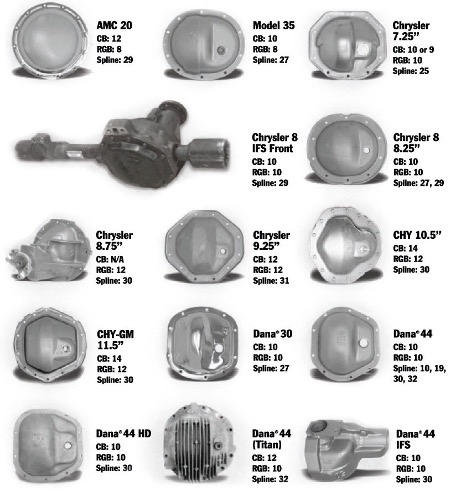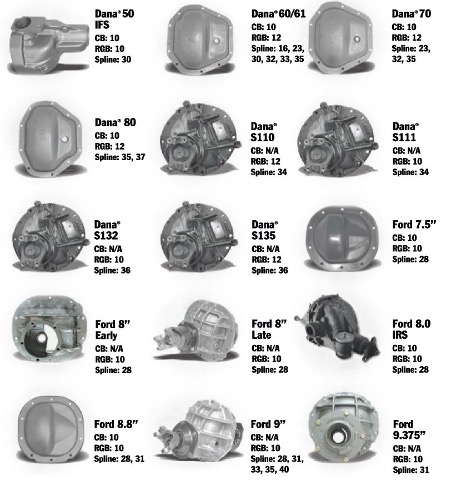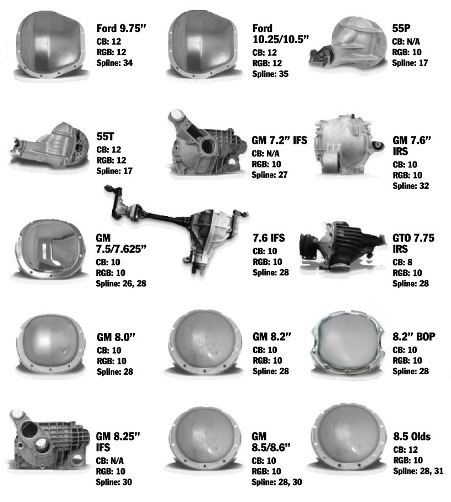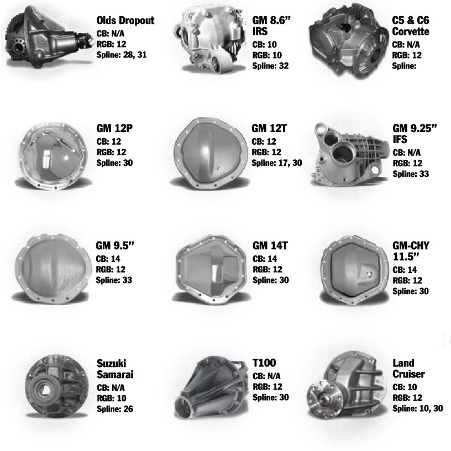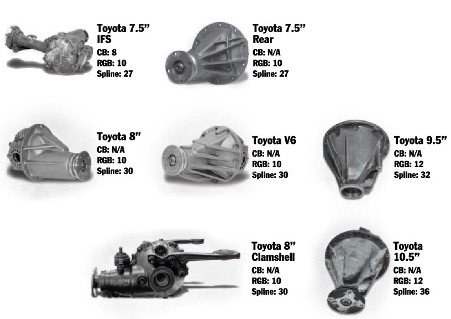
Differential identification is the first and most important step in any diff repair or upgrade. Before you order a ring and pinion, a locker, a bearing kit or even a cover gasket, you need to know exactly which axle you’re working with. Getting it wrong is the most common and most expensive mistake in diff work. A Ford 8.8 and a Ford 9.75 look similar enough at a glance in a dark garage, and almost nothing interchanges between them.
See the bottom of the page for photos to help you visually identify what model of diff you may have!
The Four Differential Identification Methods
There are four reliable ways to identify a US-market axle assembly:
- Manufacturer ID tags, fitted by Ford and others to the diff cover
- GM RPO codes, listed on the vehicle’s Service Parts Identification sticker
- Dana Spicer BOM numbers, stamped into the axle tube
- Visual identification, when there’s no tag left to read
Work through them in that order. The tag is quickest, the hardware is final.
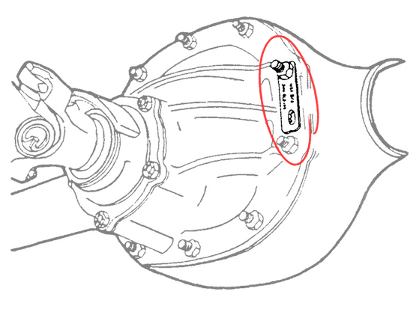
Ford Axle Identification Tags
Ford stamps an aluminium or steel identification tag that is usually held in place by one of the differential cover bolts. Location varies by model and year, but the cover is the first place to look.
The tag will give you:
- Ring gear size — which effectively tells you the axle type (8.8, 9.75, 10.25 and so on)
- Gear ratio — the numeric ratio, e.g. 3.73
- Limited slip status — whether the axle left the factory with a Traction-Lok or similar unit
Once you have the ratio off the tag, our diff ratio calculator will tell you what a change of gearing does to your speedo reading and cruising revs before you commit to a set.
If the tag is gone, which is common on anything that’s spent time on New Zealand roads or been through a rebuild, skip to the visual method below.
Watch for: the tag reflects how the axle left the factory. It says nothing about what a previous owner did to it. If someone has swapped the gearset or fitted an aftermarket diff, the tag is now a historical document, not a spec sheet.
GM RPO Codes
GM vehicles carry Regular Production Option (RPO) codes, three-character codes that designate the equipment and options fitted to that specific vehicle. They’re one of the fastest routes to identifying a GM axle without pulling a cover.
Where to find them:
- The Service Parts Identification sticker, typically in the glovebox or near the spare tyre
- On 2018 and newer GM vehicles, a QR code at the bottom of the driver’s side door pillar
Axle-related codes generally begin with F, G, or H. The G-prefix codes are the ones most people are chasing, because they describe the differential itself:
| RPO code | What it means |
|---|---|
| G80 | Locking differential. On modern trucks this is the Eaton mechanical locker, which uses clutch packs plus positive mechanical engagement and locks when wheel speed difference exceeds roughly 100–120 rpm. On older GM vehicles, G80 was used for Positraction limited slip. |
| G86 | Mechanical limited slip differential |
| G93 | Full-locking front differential |
| G94 | Full-locking rear differential |
| G96 | Electronic limited slip differential |
That G80 distinction matters more than it sounds. It’s very commonly described as “limited slip / Positraction”, and on older vehicles that’s fair, but on a late-model truck a G80 is an automatic locker, and it needs different parts and different service expectations than a clutch-type LSD.
Important caveat: RPO codes only tell you what the factory built. If the axle has been modified, regeared, or swapped, the sticker is no longer accurate. Always confirm against the hardware.
Dana Spicer BOM Numbers
Dana axles are the most precisely documented of the lot, provided you can find the stamping.
Every Spicer carrier-type axle carries a manufacturing date and a Bill of Material (BOM) number stamped into the right or left hand axle tube. On some models the BOM appears on the carrier instead, or on an identification tag. You’ll also usually find:
- The model number cast into one of the webs of the housing
- A gear ratio tag
- If it’s a limited slip, a separate tag specifying the required limited slip lubricant, worth noting before you fill it
Reading the BOM number
Traditional BOMs are six digits followed by one or two more digits, and begin with 60 or 61.
Here’s the trap: on some tags the first two digits are dropped. You might read 3994-1 on the tag, but the actual BOM is 603994-1. If your number looks two digits short, add the 60 back on.
Later BOMs can begin with 200. These three digits are not typically dropped.
Looking up a BOM
- Go to the Dana Aftermarket Media Library and enter the BOM number under “Keyword Search”
- Click the resulting literature link
- Search for the BOM inside the PDF
Using the example above, BOM 603994-1 returns a standard Dana 60 with a 3.73 gear ratio. The BOM will identify the model number, gear ratio, differential type, and the full component parts list, which is exactly what you want in front of you before ordering.
Visual Differential Identification
No tag, no sticker, no legible stamping? Visual differential identification will still get you there in most cases. Four things to check:
- The shape of the differential cover — often the single most distinctive feature
- The number of cover bolts
- The number of ring gear bolts
- The ring gear diameter — measure it, don’t estimate it
Here’s a starting-point reference for common US axles. CB = cover bolts, RGB = ring gear bolts.
Ford
| Axle | Ring gear | CB | RGB | Typical splines |
|---|---|---|---|---|
| Ford 7.5″ | 7.5″ | 10 | 10 | 28 |
| Ford 8.8″ | 8.8″ | 10 | 10 | 28 / 31 |
| Ford 9″ | 9.0″ | Drop-out third member (10 nuts) | 10 | 28 / 31 |
| Ford 9.75″ | 9.75″ | 12 | 12 | 34 |
| Ford 10.25″ / 10.5″ | 10.25″ / 10.5″ | 12 | 12 | 35 |
General Motors
| Axle | Ring gear | CB | RGB | Typical splines |
|---|---|---|---|---|
| GM 7.5″ / 7.625″ | 7.5″ / 7.625″ | 10 | 10 | 26 / 28 |
| GM 8.2″ | 8.2″ | 10 | 10 | 28 |
| GM 8.5″ / 8.6″ (10-bolt) | 8.5″ / 8.6″ | 10 | 10 | 28 / 30 |
| GM 12-bolt (car & truck) | 8.875″ | 12 | 12 | 30 |
| GM 9.5″ (14-bolt semi-float) | 9.5″ | 14 | 12 | 33 |
| GM 10.5″ (14-bolt full-float) | 10.5″ | 14 | 12 | 30 |
| AAM 11.5″ | 11.5″ | 14 | 12 | 30 |
Dana Spicer
| Axle | Ring gear | CB | RGB | Typical splines |
|---|---|---|---|---|
| Dana 30 | 7.125″ | 10 | 10 | 27 |
| Dana 35 | 7.562″ | 10 | 10 | 27 |
| Dana 44 | 8.5″ | 10 | 10 | 19 / 30 |
| Dana 60 | 9.75″ | 10 | 12 | 30 / 35 |
| Dana 70 | 10.5″ | 10 | 12 | 32 / 35 |
| Dana 80 | 11.25″ | 10 | 12 | 35 / 37 |
Note that cover bolt count alone is rarely conclusive, as a great many axles use 10 bolts. Combine it with cover shape and a measured ring gear diameter and you’ll get there.
Differential Identification on Modified Axles
Every method above tells you what the factory fitted. None of them tell you what’s in there now.
This is where differential identification catches people out on imports. If the vehicle arrived with unknown history, or shows any sign of previous diff work, treat tags and RPO codes as a strong hint rather than proof. Pulling the cover and counting ring gear bolts takes twenty minutes and costs a gasket. Ordering the wrong gearset costs considerably more.
Need Help With Differential Identification?
Once you know what you’ve got, browse the shop for gearsets, lockers and bearing kits, or have a look at what we do in the workshop if you’d rather hand the whole job over.
Gearhead Diffs — differential parts, repairs and builds, based in Christchurch and shipping New Zealand wide.