
Most vehicles come from the factory with an open differential, which works well for normal road driving. However, many performance vehicles and 4WDs benefit from upgrading to a limited slip differential (LSD).
Understanding the difference between these two differential types can help explain why traction is sometimes lost and how upgrading to an LSD can dramatically improve vehicle performance.
What Does a Differential Actually Do?
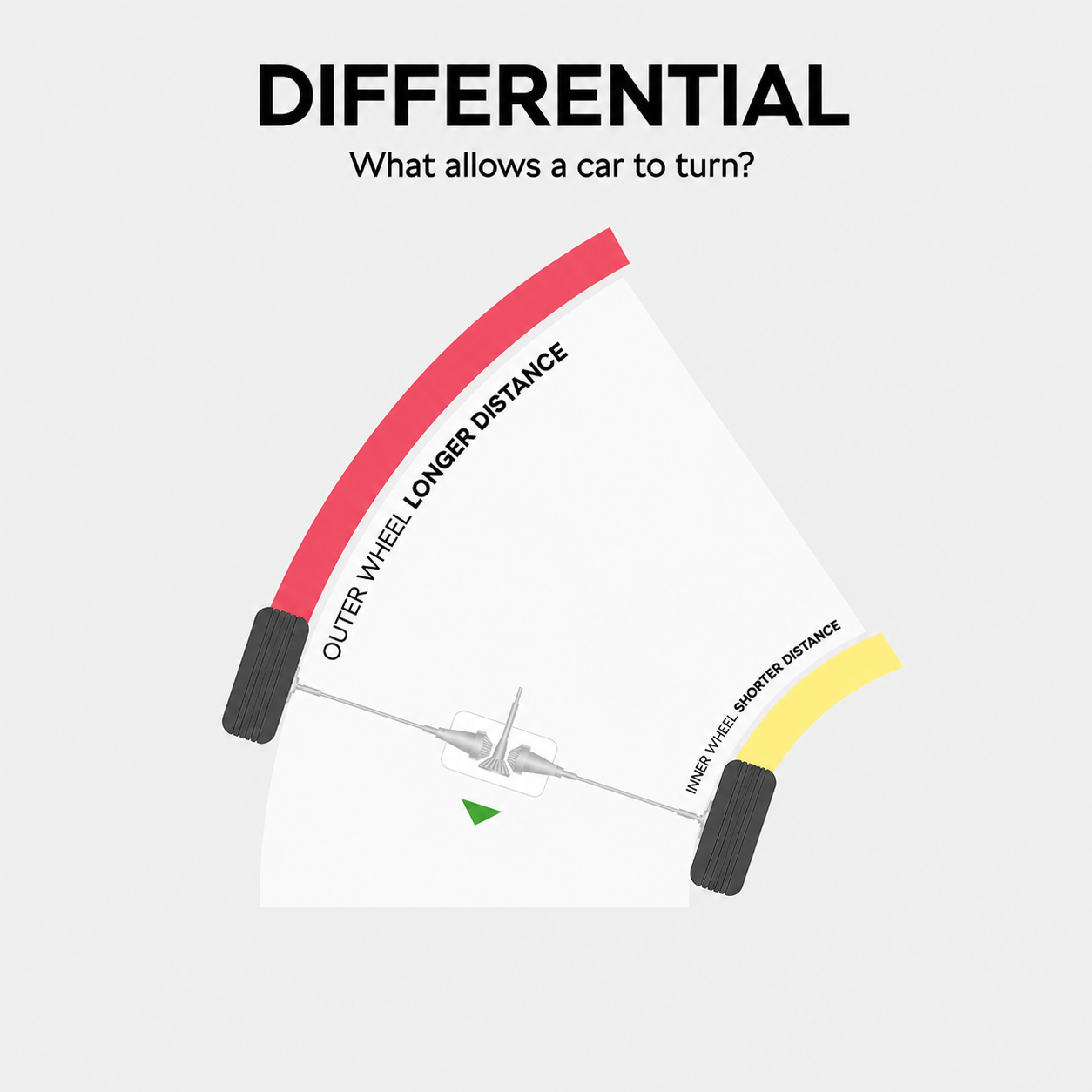
A differential allows the left and right wheels on the same axle to rotate at different speeds when the vehicle turns.
When cornering, the outside wheel travels further than the inside wheel, so the differential allows this speed difference while still delivering power from the engine to the wheels.
Without a differential, the vehicle would be harder to turn and the wheels would skip on the ground because they could not move at different speeds.
What Is an Open Differential?
An open differential is the most common type found in vehicles.
Inside the differential carrier are a set of gears that allow each wheel to rotate independently while distributing the power between them.
Under normal conditions this system works well and provides smooth and predictable handling.
However, open differentials have one significant limitation.
If one wheel loses traction, the differential will send most of the power to the wheel with the least resistance.
This means that if one wheel is on mud, gravel, or lifted off the ground, it will spin freely while the wheel with traction receives very little to no power at all.
What Is a Limited Slip Differential (LSD)?
A limited slip differential (LSD) is designed to reduce the amount of power lost when one wheel begins to slip.
Instead of allowing all the power to go to the wheel with the least grip, an LSD limits the speed difference between the wheels and transfers more torque to the wheel that still has traction.
Limited slip differentials are commonly used in:
- Performance cars
• Motorsport vehicles
• 4WD and off-road vehicles
• High power street cars
By improving traction, LSDs can significantly improve acceleration, stability, and overall vehicle performance.
Advantages of a Limited Slip Differential
Improved Traction
Because torque can still be delivered to the wheel with grip, the vehicle is less likely to lose drive when traction is uneven.
Better Acceleration
An LSD allows both wheels to contribute to acceleration rather than allowing one wheel to spin. This is why LSDs are commonly installed in performance vehicles and race cars.
Improved Vehicle Stability
By reducing wheel spin, LSDs can make a vehicle feel more predictable when applying power, particularly when exiting corners or driving on loose surfaces.

When an Open Differential Is Still Suitable
Although LSDs provide clear performance advantages, open differentials are still suitable for many everyday vehicles.
Open differentials provide:
- Smooth and quiet operation
- Minimal maintenance requirements
For vehicles used primarily for commuting and normal road driving, an open differential usually performs perfectly well.
Upgrading to an LSD
Many vehicles can be upgraded from an open differential to a limited slip differential.
This upgrade is particularly popular for performance builds and off-road vehicles where improved traction is beneficial.
Common LSD brands include:
- Cusco
- Kaaz
- Eaton Trutrac
- OS Giken
- Disc trac
- Wavetrac
Installing a quality LSD can dramatically improve how a vehicle puts power to the ground.
Differential Rebuilds and LSD Upgrades
At Gearhead Diffs, we specialise in differential rebuilds and upgrades for a wide range of vehicles including performance cars, 4WDs, and commercial vehicles.
If you’re considering upgrading to a limited slip differential or experiencing traction issues with your current setup, our team can help recommend the best solution for