
Ford 9 Inch Diff Conversion for Holden HQ to WB: The Complete Guide
Building a HQ, HJ, HX, HZ or WB Holden with real horsepower on tap? Then the factory Salisbury or 10-bolt banjo diff is usually the first thing to fail. That’s why a Ford 9 inch diff conversion has become the standard upgrade for HQ-WB owners. Whether it’s a built 355, a turbo LS, or a big-block behind a manual gearbox, the 9 inch handles it. But the factory diff doesn’t.
This guide covers what a Ford 9 inch conversion actually involves on a HQ to WB Holden. First, we’ll walk through housing options, axles, gearing and brakes, and what it costs. Then we’ll explain why the fabrication and setup work matters more than the parts list.
Why HQ-WB Owners Convert to a Ford 9 Inch Diff
Holden never designed the factory Salisbury (10-bolt) diff for big power. So its two-pinion spider gear arrangement is the first thing to break once you’re putting real torque through it. And once you break an axle, you’re back under the car again.
By contrast, Ford built the 9 inch differently. Here’s why it’s become the go-to conversion for HQ, HJ, HX, HZ and WB Holdens:
Removable centre section. The “banjo” style pumpkin drops out the front of the housing. So you can pull the centre, swap ratios, or rebuild it — without dropping the whole diff out of the car.
Stronger third member design. A larger, more robust bearing setup supports the pinion, and the ring gear sits differently in the housing. Both spread load better than the Salisbury’s design. As a result, it’s a proven unit under serious horsepower in drag cars, street cars and off-road builds worldwide. So parts and expertise are everywhere.
Modular gearing. Because the centre comes out as a complete unit, you can run one ratio and LSD setup for the street. Then swap in a strip-spec centre with a different ratio and a spool for the track. No need to touch axles, brakes or brackets.
Huge aftermarket support. You get nodular iron and cast third members, plus big bearing (Daytona) and small bearing pinion supports. Gear ratios and limited-slip options run the full range too, from Disctrac through to a full spool. In short, that’s a level of aftermarket support Salisbury internals can’t match once you’re past mild upgrades.\
What’s Actually Involved in a HQ-WB Ford 9 Inch Conversion
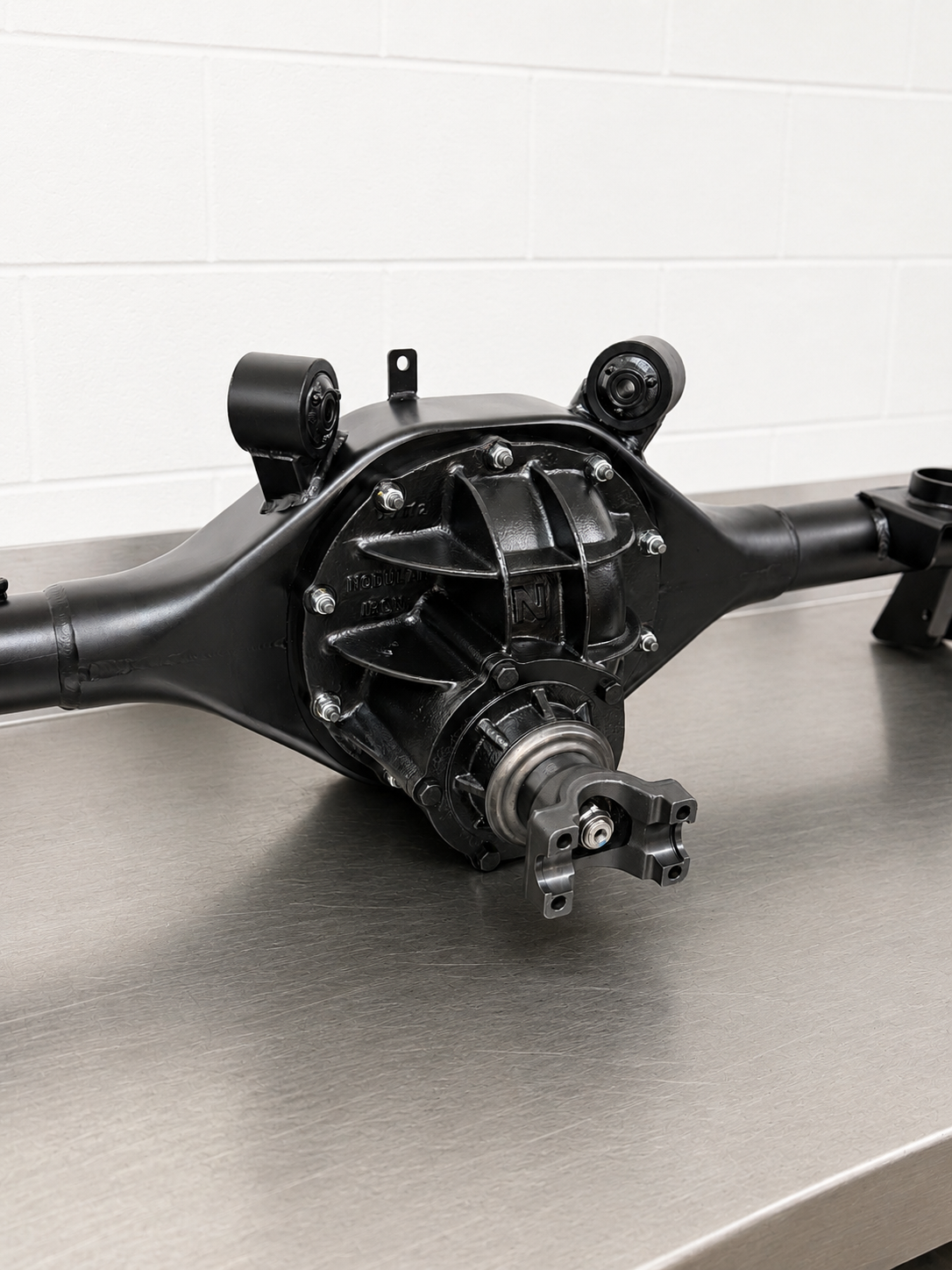
This is where a lot of HQ-WB owners get caught out. Ford didn’t build the 9 inch for a Holden. So getting one to sit correctly under a HQ-WB comes down to a series of mounts on the housing — each one has to land in the right position and at the right angle. It’s easy for one of them to be slightly out, and that’s enough to throw the whole geometry off.
Specifically, a proper conversion means the housing needs:
Coil spring perches in the exact HQ-WB position, or ride height and spring rate come out wrong.
Radius rod (control arm) mounts at the correct location and angle, since these locate the diff and set pinion angle under load.
Track bar (Panhard rod) mount in the right spot, so the diff stays centred without side-to-side axle steer.
Shock mounts at the correct height and angle for your shocks.
Correct axle width for your HQ-WB track and wheel/tyre combo, especially if you’re running wider rubber or need guard clearance.
Get any one of these wrong, even slightly, and you’ll fight it forever: wandering under brakes, wheel hop, tyre rub, or a pinion angle that eats tailshaft universals and centre bearings. So this is the part of the job that separates a housing that looks right from one that actually drives right. In other words, it’s not something you want to eyeball.
Housing Options: Factory Width, Narrowed and Leaf Spring (Ute) Fitments
We supply HQ-WB Ford 9 inch housings to suit your car and wheel combination, with a few standard options:
Factory width — matches original HQ-WB track width for a factory-style fitment.
40mm narrower overall — for wider wheels that need extra guard clearance, while the rest of the suspension geometry stays unchanged.
Leaf spring housings for ute versions — HQ-WB utes and panel vans run a leaf-sprung rear end, not coils. So these get a dedicated leaf spring housing, not a coil-spring conversion.
All of our housings come standard with factory Holden wheel bearing ends. That means you can reuse your existing Holden brakes instead of sourcing a separate brake package.
Axles: Spline Count and Bearing Ends
All of our complete HQ-WB Ford 9 inch packages come standard with 31 spline axles. That’s a solid step up in strength from the factory 28 spline Ford axle, and the right balance for street/strip use.
Every one of our ready-to-go bolt-in housings runs factory Holden HQ bearing ends as standard. As a result, your Holden brakes, wheel bearings and hubs bolt straight up — no adapters, no non-standard parts.
So, for serious power or hard launches, we offer 35 spline axles as an upgrade against breakage.
Gear Ratios and LSD Options
One of the biggest advantages of the 9 inch conversion is the sheer spread of gear ratios available. For instance, we can supply anything from 2.5:1 for open-road cruising through to 7.33:1 for serious strip and big-tyre combinations. Plus, there are plenty of ratios in between to dial in the right setup for your car. Because the centre section is modular, changing ratio later doesn’t mean pulling the whole diff.
For limited-slip and locking options, common choices for a street-driven HQ-WB are:
- Disctrac LSD — our preferred limited-slip unit for HQ-WB conversions, giving predictable, durable performance on the street and under load.
- Clutch-type LSD (e.g. Eaton) — traditional limited-slip feel, needs friction modifier in the oil, good for street/strip.
- Detroit Locker — full locking under power, popular for drag applications, more aggressive on the street.
- Spool — no differential action at all, strip-only, not for a car that sees the street.
Brakes: Keeping Holden or Going Ford
This is one of the most common questions on a HQ-WB conversion. You’ve got two paths:
Retain Holden brakes. With the right combination, you can run factory or upgraded HQ-WB Holden disc brakes on a Ford 9 inch housing. So your handbrake mechanism and caliper setup stay familiar. That said, check spring perch and caliper clearance carefully here. Otherwise, get the brackets wrong and factory HZ/WB caliper positions will foul the coil springs.
Fit a Ford 9 inch disc brake kit. Aftermarket 9 inch disc brake kits, often based on later Falcon or big-brake kits, bolt straight to the housing ends. So they give you a wider range of rotor and caliper upgrade options. Worth considering, especially if you’re chasing stopping power to match the extra grunt going through the diff.
What Does a Ford 9 Inch Conversion Cost?
Pricing varies depending on housing choice, axle spline, gear ratio, LSD type and brake package. But the biggest contributor is the internals: which diff centre and housing spec you’re running. For example, sedan and wagon housings use the same unit. However, they cost a little more than the ute housing because of the extra bracket work it needs. Since every build is different, the most accurate number comes from a quote for your specific car and combination.
DIY vs Getting It Built Properly
A 9 inch conversion is a more realistic home project on leaf-spring cars, where the mounting points are relatively simple. By contrast, HQ-WB sedan and wagon housings are a different story. The coil spring perches, radius rod mounts and track bar mount all need exact position and angle. In practice, that means working from a proper jig to hold everything true while we weld it, not something you can eyeball with a level and tape measure. That’s because small errors in perch angle or pinion angle don’t show up as a build-day problem. Instead, they show up months later as vibration, tailshaft wear, wheel hop or premature diff failure.
So, getting real power, a lowered stance, or just want it Done once and done Right? Then get someone who does this conversion regularly to build and set up your housing. That way, they’ll have the jigs to get the bracketry right the first time.
FAQs: Ford 9 Inch Diff Conversion for HQ-WB Holden
Will a Ford 9 inch diff bolt straight into a HQ, HJ, HX, HZ or WB Holden? No — a factory Ford 9 inch housing won’t bolt in as-is. It needs coil spring perches, radius rod mounts, a track bar mount and shock mounts that match Holden geometry. That comes either from a HQ-WB specific bolt-in housing or a custom-built one.
Can I keep my Holden disc brakes after converting to a Ford 9 inch diff? Yes, in most cases. Just use the correct axle end and bearing type, and set the brackets up to clear the coil springs properly.
What spline count axle should I run in my HQ-WB Ford 9 inch conversion? All of our bolt-in packages come standard with 31 spline axles, the most common choice for a street/strip HQ-WB. However, we also offer 35 spline as an upgrade if you’re chasing serious horsepower or hard launches.
What’s the best LSD for a street-driven HQ-WB with a 9 inch diff? A Disctrac LSD is the best option for a street-driven HQ-WB: predictable, low-maintenance, and it only works when needed. So there’s no horrible binding in tight, slow cornering situations.
How much does a Ford 9 inch diff conversion cost in New Zealand? It depends on housing type, axle spline, gearing and brake package. So the best way to get an accurate number is a quote based on your specific HQ-WB and combination.
Is a Ford 9 inch diff conversion worth it for a mild street HQ-WB? If you’re staying at factory-ish power levels, a built factory diff may hold up fine, and we have plenty of options for this too. But once you’re building the engine, adding boost, or running a manual with torque, the 9 inch conversion pays for itself.
Get Your HQ-WB Ford 9 Inch Conversion Done Once and Done Right
At Gearhead Diffs, we supply Ford 9 inch diff conversions for HQ, HJ, HX, HZ and WB Holdens, covering sedan, wagon and ute. We have ready-to-go bolt-in housings in standard width or 40mm narrower, and we can also customise the width to suit your application.
So get in touch with the team to talk through spline count, gear ratio, LSD choice and brake compatibility. Or get a quote on a housing built specifically for your HQ-WB.