
Picking the right axles for your Ford 9-inch or BorgWarner build.
If you’re building a rear end for a Falcon, a Commodore, a Kingswood or anything running a Ford 9-inch or BorgWarner, the spline count is one of the first real decisions you’ll make. Get it right and the axles will outlive the car. Get it wrong and you’ll be picking pieces out of the diff after a hard launch.
What spline count actually tells you
The splines are the grooves cut into the end of the axle where it locks into the centre or spool. More splines means a larger-diameter shaft, and a bigger shaft resists twisting and snapping far better when you dump the clutch or hook up on a sticky track. In short, for these diffs the higher the number, the bigger the axle and the more torque it takes before it lets go, though that doesn’t hold true across every axle family out there.
| Spline | Shaft dia. | Best for |
|---|---|---|
| 28 | 1.20″ (30.5 mm) | Stock to mild street |
| 31 | 1.31″ (33.3 mm) | Serious street & strip |
| 35 | 1.50″ (38.1 mm) | Big power & race |
28 spline axles — the standard
This is what most of these cars rolled out of the factory with. The stock BorgWarner and the base Ford 9-inch both run 28 spline — though some BorgWarners came out with 25-spline axles, so it pays to check what you’ve actually got. For a stock or lightly worked street car, 28 spline is perfectly fine. Step up to an aftermarket high-strength billet steel (EN1440) 28-spline axle and you’ve got a tidy, affordable setup that handles a solid street tune without drama.
31 spline axles — the sweet spot
For most of the builds we see, 31 spline is the one to reach for. That jump from 1.20″ to 1.31″ adds a genuine chunk of strength for not much more money, and it comfortably copes with a healthy V8, sticky tyres and repeated hard launches. If you’re making real power and driving the car like you mean it, this is where the smart money goes.
Here’s a tip worth knowing: if you’ve got a 25-spline BorgWarner and you’re looking at a new LSD centre to step up to 28 spline, it usually makes sense to jump straight to 31. The centre and a set of new billet cut-to-length axles cost the same in either spline choice, so you may as well grab the extra strength while you’re in there.
35 spline axles — the heavy hitter
When you’re deep into big-cube, forced-induction or dedicated race territory, 35 spline is the serious end of the scale. The 1.50″ shaft — like the gun-drilled units we run from Revolution Gear — shrugs off torque that would twist a 28. It’s mostly overkill for a weekend cruiser, but if you’ve got serious power and drive it extra hard, it could still be a smart choice.
Don’t forget the centre. You can’t just swap axles in isolation. The spline count has to match your centre or spool, and stepping up to 31 or 35 usually means a matching carrier — and sometimes different housing ends. Sort the whole package together, not one piece at a time.
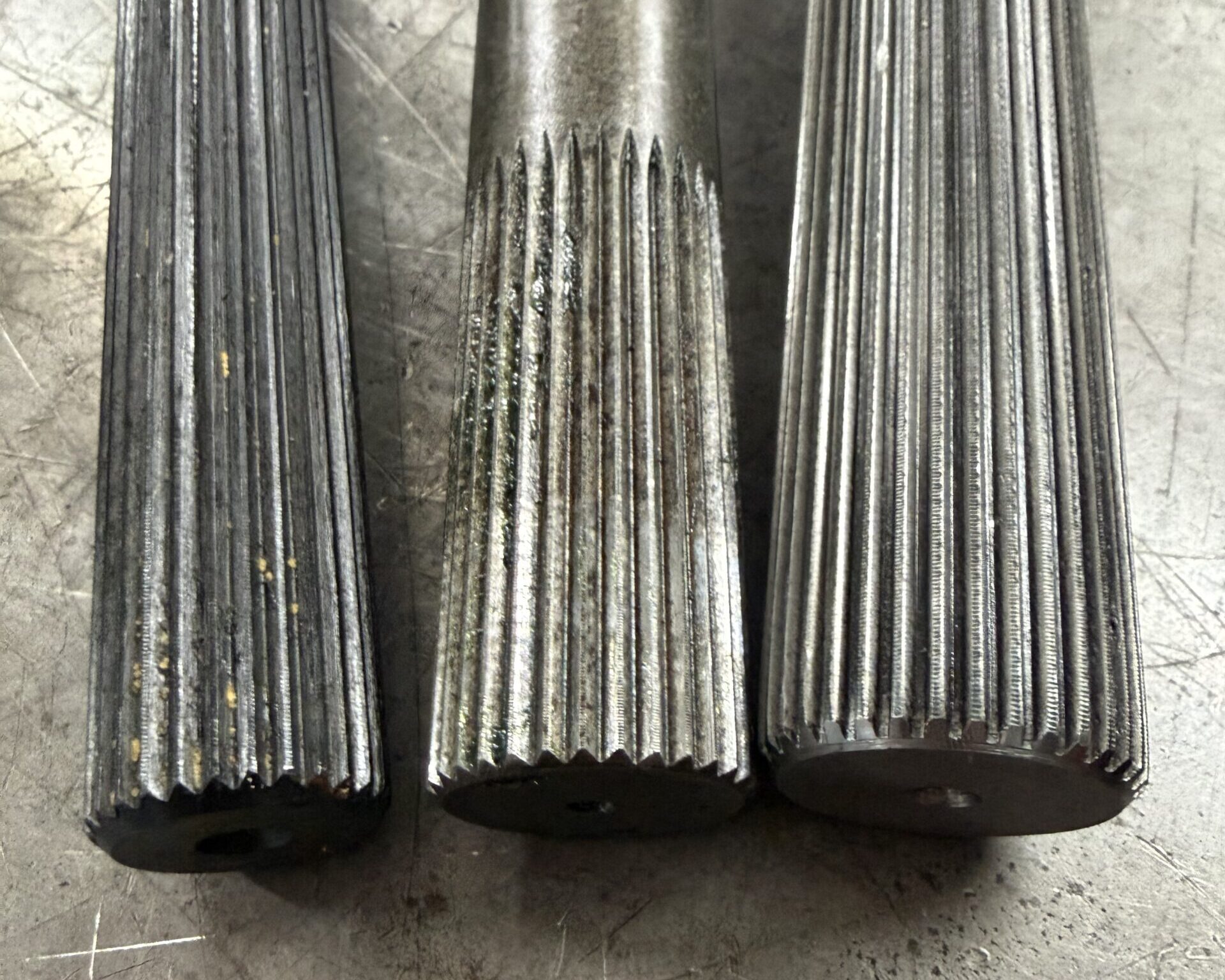
So which one?
Stock or mild street car — 28 spline does the job. Building a strong street or street/strip weapon — go 31 and never think about it again. Chasing serious numbers at the track — that’s 35 spline country. When in doubt, buy the strength once rather than twice.
Not sure what your combo needs? Flick us the details of your build and we’ll point you at the right setup