
If you’ve ever asked yourself “What diff ratio do I have?” or wondered how to work out a diff ratio, you’re not alone.
Knowing your differential ratio is important when planning modifications, diagnosing drivability issues, changing tyre sizes, or purchasing a replacement diff.
Whether you’re trying to find your diff ratio, identify an unknown diff, or working out the gearing in a new vehicle, there are several simple methods.
In this guide, we’ll explain how to work out diff ratio, how to calculate diff ratio, and potential ways to identify the ratio currently in your vehicle.
What Is a Diff Ratio?
A differential ratio (also known as a final drive ratio) describes how many times the pinion gear rotates for one complete rotation of the crownwheel.
For example:
- 3.54:1 ratio = pinion rotates 3.54 times for one crownwheel rotation
- 4.11:1 ratio = pinion rotates 4.11 times for one crownwheel rotation
- 4.88:1 ratio = pinion rotates 4.88 times for one crownwheel rotation
Generally speaking:
- Lower numerical ratios (3.23, 3.45, 3.54) provide lower engine RPM at highway speeds.
- Higher numerical ratios (4.56, 4.88, 5.29) provide more torque multiplication, improved acceleration and higher RPM at highway speeds.
What Diff Ratio Do I Have?
There are several ways to determine what diff ratio is fitted to your vehicle.
The most common methods include:
- Counting crownwheel and pinion teeth
- Checking factory identification tags
- Reading the factory stamped numbers on either the crownwheel or pinion
- Rotating the wheels and counting tail shaft revolutions
- Using a differential ratio calculator
Some methods provide an exact ratio, while others provide a close estimate.
How to Calculate Diff Ratio Using Tooth Counts
The most accurate way to calculate a differential ratio is by counting the teeth on the crownwheel and pinion.
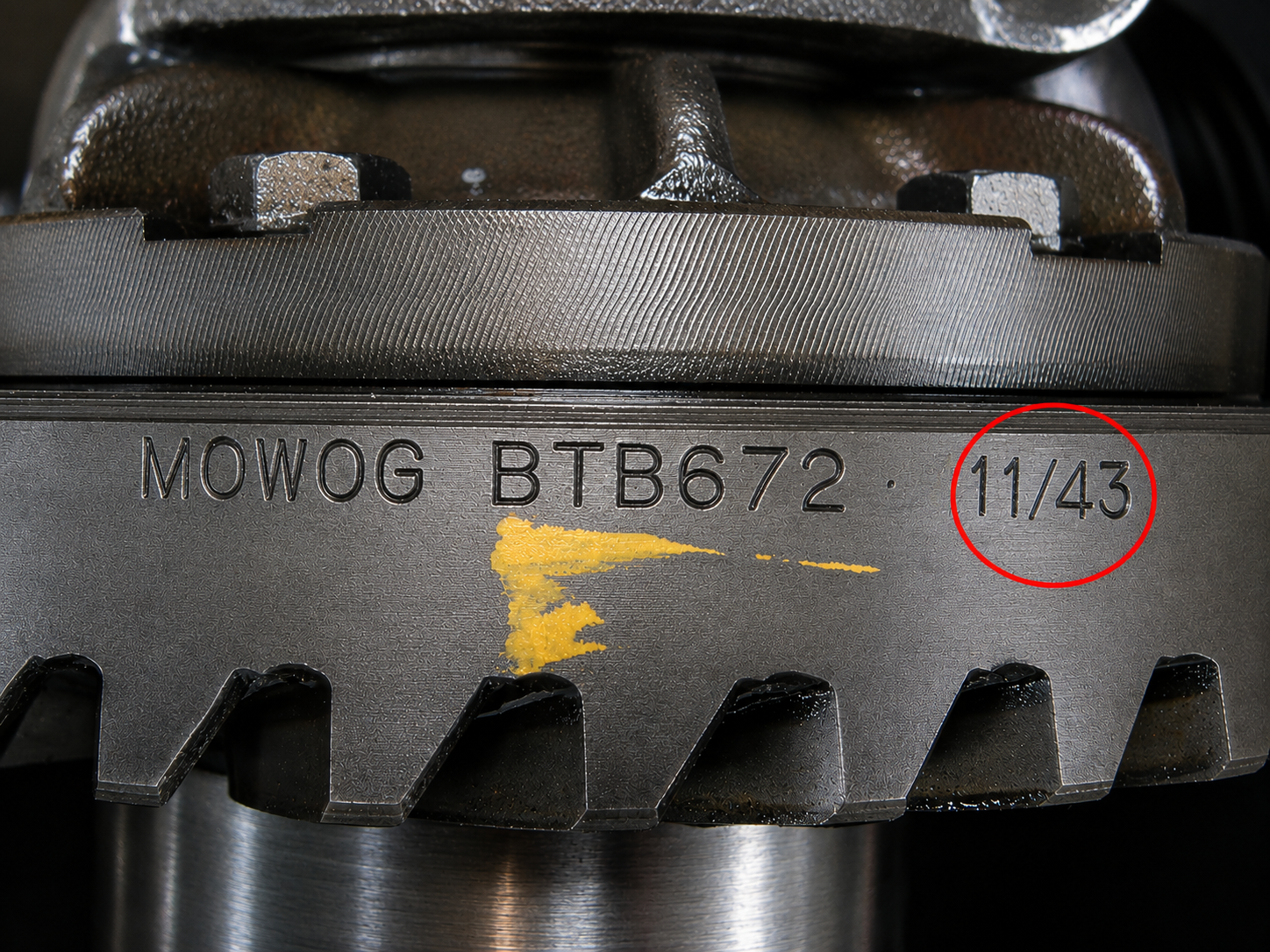
Some crownwheels have the tooth count stamped directly onto the edge of the gear.
For example:
41-10
This means:
- Crownwheel = 41 teeth
- Pinion = 10 teeth
To calculate the ratio:
41 ÷ 10 = 4.10
Therefore:
Diff Ratio = 4.10:1
Other examples include:
- 39 ÷ 11 = 3.54
- 41 ÷ 10 = 4.10
- 37 ÷ 9 = 4.11
- 43 ÷ 10 = 4.30
- 39 ÷ 8 = 4.875 or commonly referred to as 4.88
This method provides the exact differential ratio and is the preferred approach during a rebuild.
Using a Differential Ratio Calculator
Many people use a differential ratio calculator to verify ratios after counting teeth.
Simply enter:
- Crownwheel tooth count
- Pinion tooth count
The calculator will divide the two numbers and provide the ratio.
While a differential ratio calculator can be a useful way to double-check your calculations, the process can be performed just as easily using a standard calculator by dividing the number of crownwheel teeth by the number of pinion teeth.
For example:
- 41 ÷ 10 = 4.10
- 39 ÷ 8 = 4.875 (commonly referred to as 4.88)
This can be particularly useful when identifying unknown gear sets or verifying that a differential contains the ratio you expect. This can also be done on a normal calculator by simply dividing the number of teeth on the crownwheel by the number of teeth on the pinion.
How to Find Your Diff Ratio by Rotating the Wheels
If the differential is still installed in the vehicle, you can estimate the ratio by rotating the wheels.
For an open differential:
- Raise both drive wheels off the ground.
- Mark the tailshaft.
- For an open diff, rotate one wheel two complete revolutions. For an LSD, or if where both wheels rotate together at the same speed and in the same direction, rotate the wheel one complete revolution.
- Count the number of tailshaft revolutions.
Example:
- Wheel rotates twice.
- Tailshaft rotates approximately 4.1 times.
Result:
4.10 Ratio
While not quite as accurate as physically counting the crownwheel and pinion teeth, this method is usually accurate enough to identify the differential ratio fitted to a vehicle.
Before carrying out this test, it can be helpful to check which differential ratios were available from the factory for your particular vehicle. Knowing the factory ratio options will give you a better idea of the possible ratios you are likely to find and make the results easier to interpret.
Common Diff Ratios
Some of the most common differential ratios we encounter include:
| Ratio | Common Applications |
|---|---|
| 3.07/3.08 | Highway cruising |
| 3.45/3.46 | Street performance |
| 3.54 | Factory performance vehicles |
| 3.73 | Many modern 4WDs |
| 4.10 | Larger tyres and towing |
| 4.30 | Performance applications |
| 4.56 | 35″ tyre setups |
| 4.88 | 35–37″ tyre setups |
| 5.29 | 37–40″ tyre setups |
The ideal ratio depends on tyre size, transmission ratios, engine characteristics, intended use, and overall vehicle setup.
Why Knowing Your Diff Ratio Matters
Your differential ratio affects:
- Acceleration
- Engine RPM
- Fuel economy
- Off-road capability
- Highway drivability
This becomes particularly important when:
- Fitting larger tyres
- Changing wheel sizes
- Swapping transmissions
- Performing engine conversions
- Building a performance vehicle
A ratio that works perfectly with factory tyres may become completely unsuitable once tyre diameter changes.
Can the Diff Ratio Be Changed?
In most cases, yes.
Changing the differential ratio involves replacing the crownwheel and pinion gears with a different ratio set.
Common reasons for changing ratios include:
- Re-gearing a 4WD after fitting larger tyres
- Improving towing performance
- Restoring factory drivability
- Improving acceleration
- Optimising gearing after a transmission swap
Choosing the correct ratio can dramatically improve vehicle performance and drivability.
Final Thoughts
Whether you’re wondering “how to work out a diff ratio”, planning a wheel and tyre upgrade, changing transmissions, or learning how to calculate differential ratios, the methods above provide a reliable starting point. Knowing your differential ratio can help you make informed decisions about vehicle performance, engine RPM, towing capability, fuel economy, and drivability. By following these steps, you can accurately identify the ratio fitted to your vehicle and determine whether it is suitable for your intended use.
The most accurate method is always counting the crownwheel and pinion teeth, but wheel rotation methods can provide a quick estimate when the differential remains assembled.
If you’re trying to determine the correct diff ratio after changing wheel and tyre sizes or performing a transmission swap, read our blog on Choosing the Right Diff Ratio.
If you’re still unsure how to work out a diff ratio that your vehicle has, or which ratio would best suit your application, get in touch with Gearhead Diffs and we’ll be happy to help.